
In work-at-height and rescue equipment, the energy absorber (also called a shock absorber pack or lanyard pack) is the component you never notice — until the moment it takes the hit for you. How does it work? And can it be used again after a fall? This article explains both.
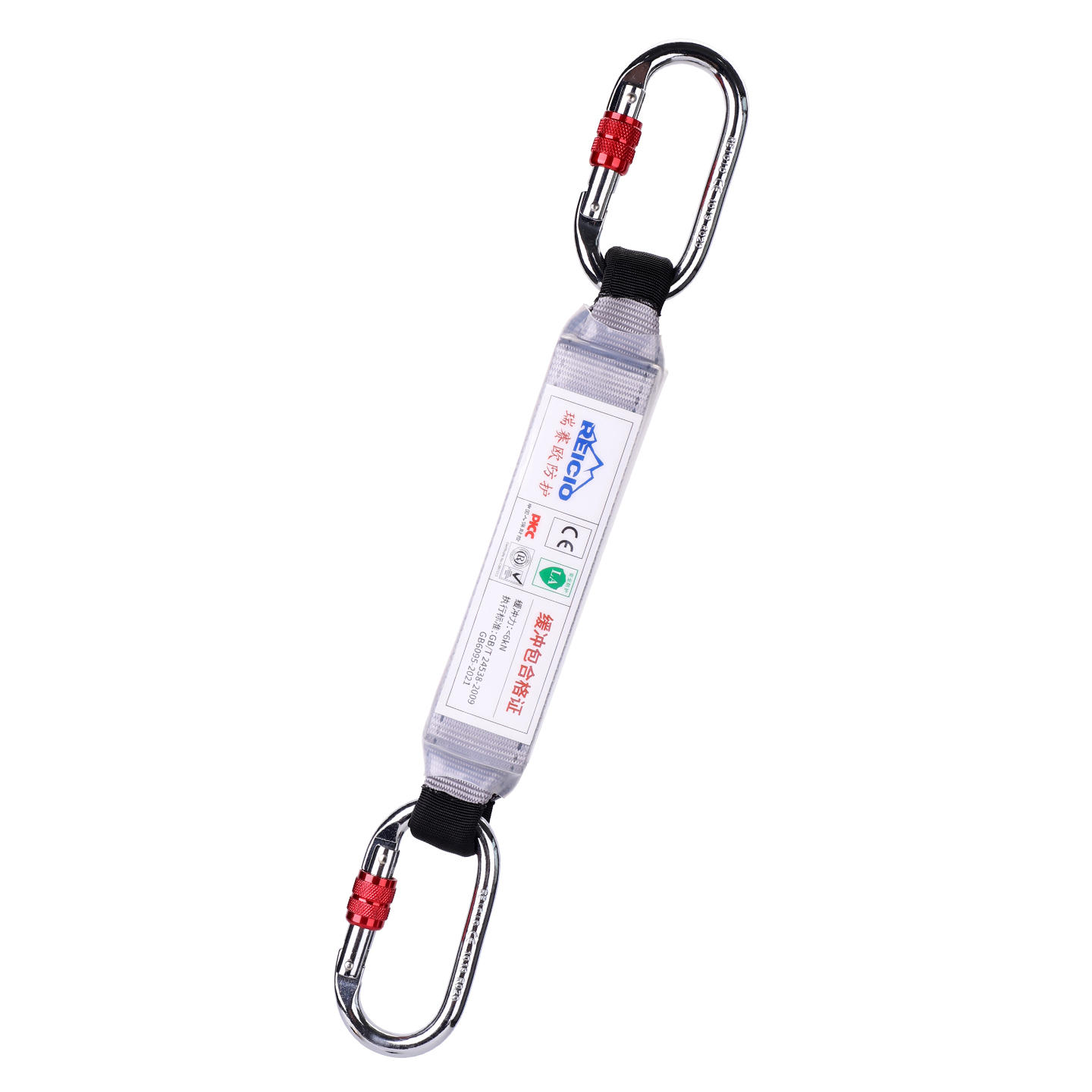
1. What does an energy absorber do?
When a person falls, the arrest force at the moment the system catches them is far greater than body weight. The job of the energy absorber is to swallow part of that energy in a fraction of a second:
- When a fall occurs, the absorber opens and the internal webbing tears out and extends, which is the actual cushioning action.
- That extension process reduces the force of the fall and limits the injury load on the person.
In other words, it absorbs energy by tearing and extending its own structure — the deployment is the function.
2. Can it be used again after a fall? No
The answer is unambiguous: an energy absorber is a single-use component — once it has deployed, it no longer works.
The reason follows from the principle above: it absorbs energy by tearing and stretching its internal webbing. That process is irreversible and cannot be reset. Once deployed, the “budget” has been spent. It may still look fine on the outside, but in a second fall it will no longer provide the original cushioning capacity.
So the criterion is not “does it look damaged” but “has it ever been involved in an actual fall arrest?”
3. How to tell that it has already deployed
- The sleeve length has changed: if the transparent sleeve is noticeably longer and the internal webbing has been pulled out, the absorber has deployed.
- Stitching has been pulled apart: broken or loosened seams along the deployment direction.
- Tear marks on the surface: visible rips or deformation of the protective cover.
- Unknown history: if it cannot be confirmed whether the unit has taken an impact, it should not be used.
One more thing: even if the unit looks perfect, if it has participated in a fall arrest it must be retired — the energy has been consumed.
4. Checks to make before every use
Before each use, inspect the lanyard and related equipment thoroughly:
- Lanyard and harness: check webbing and rope for abrasion, cuts, corrosion or ageing.
- Metal components (hooks, D-rings, fall arresters): confirm there is no deformation, cracking or corrosion, and that the gate locks correctly.
- Anchor point: confirm the fixing point is sound and reliable and can withstand an impact of at least 15 kN (about 1,500 kg).
Inspection means looking and feeling — not just a glance. If anything is in doubt, take the equipment out of service first.
5. Usage limits that are easy to overlook
- Do not use where clearance is below 2 m. With insufficient fall clearance the absorber cannot extend fully, which can itself cause injury.
- It is a single-use component, not resettable equipment. It cannot be stitched back or pressed back into service.
- Systems must match. The strength of the absorber, the connectors and the anchor point must be compatible; a weakness in any one of them affects the whole system.
- Storage matters too. Avoid long-term contact with chemicals, open flame and high temperatures, and protect against moisture and mechanical damage.
6. Common questions
1. It was only lightly grazed — does that still mean retirement?
What matters is whether it took part in a fall arrest. If there was no fall and only a light knock, and inspection passes, it can stay in service. Once it has participated in a fall arrest, it must be retired regardless of appearance.
2. Can the absorber unit be replaced on its own?
It depends on the construction. On one-piece lanyards, where the absorber is sewn into the rope or webbing, it cannot be replaced separately. On modular versions that connect with a connector, replacement follows the manufacturer’s instructions and the replacement connector must match the original strength rating.
3. Can a used absorber be used as an ordinary rope?
No. An energy absorber is a PPE component; once it has lost its energy-absorbing capacity it has lost its safety function and must not be used in any protection system.
Closing note
This article is product-use guidance. The standards and figures referenced here are governed by the product instructions and the corresponding test reports. If in doubt, retire the component and replace it.
Prepared by REICIO (Taizhou Anto Protective Equipment Co., Ltd.), a manufacturer of CE-certified fall protection and height safety equipment.
